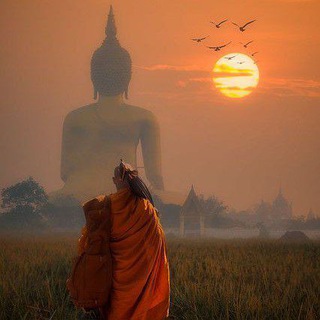
Buddha
Buddha dharma teachings from the suttas and commentaries
- 24 hours
- –
- 7 days
- –
- 30 days
- –
- Reactions
- 3
- Reposts
- –
- Comments
- –
Subscriber growth
We started tracking this channel recently; the chart fills in day by day.
Buddha has 1,412 subscribers. A typical post is seen by about 40 people within a day, an engagement rate of 2.8%.
Views as a post ages
Average views at each age, posts of the last 30 days.
- 24 h
- 40
- 48 h
- 41
- 3 days
- 109
When it posts
Times in UTC. 20 posts in 90 days.
Recent posts
-
Photo
View in Telegram
101 views 2 Reactions
-
The more observant we are, the easier we’ll find it to let go, until the stubbornness has disappeared, and we’ve become peaceful and happy. This work compensates us with great profit and with a security that can be found nowhere else. At bottom we all know about the factors that make up the spiritual life, but acting in accordance with them is very hard. Loving-kindness, compassion, sympathetic joy, and equanimity are the four highest emotions, the only ones worth having. They bring us to a level on which life gains breadth, greatness, and beauty and on which we stop trying to make it run the way we want it to—on which we even learn to love something that we may not have wanted at all. The...
38 views 3 Reactions -
The Four Highest Emotions Ayya Khema on cultivating loving-kindness, compassion, sympathetic joy, and equanimity. Part 3 of 3 The Buddha called the fourth and last of these emotions the greatest jewel of all: equanimity. It’s the seventh factor of enlightenment, and its far enemy is excitement. The near enemy is indifference, which is based on intentional unconcern. By nature we take an interest in everything. We would like to see, hear, taste and experience everything. But since we have often been disappointed by our incapacity to love, we build an armor of indifference around us, to protect us from further disappointment. But that only protects us from loving and opening ourselves to t...
34 views 2 Reactions -
Ayya Khema
-
Photo
View in Telegram
59 views 4 Reactions
-
“Mendicants, if sentient beings only knew the fruit of giving & sharing, they would not eat without first giving, & the stain of stinginess would not occupy their minds. They would not eat without sharing even their last mouthful, their last morsel, so long as there was someone to receive it. It is because sentient beings do not know, as I do, the fruit of giving & sharing, that they eat without first giving, & the stain of stinginess occupies their minds.” “If sentient beings only knew how great is the fruit of giving & sharing as taught by the great seer! Rid of the stain of stinginess, with clear & confident heart, they would duly give to the noble ones, where a gift is very fr...
-
Seeing With The Eye of Dhamma SAMADHI WITHIN THE PATH OF CULTIVATION By Buddhadasa Bhikkhu Part 7 of 14 Find a Kalyanamitta, but Let Practice Be the Teacher The second basic need is a splendid, noble friend (kalyanamitta) who will give us assistance. In the past, the teacher of a meditation practice wasn’t referred to as acariya, master or teacher, as today. Instead, practitioners spoke of kalyanamitta. The Buddha is recorded to have said that all beings subject to birth, aging, sickness, and death, should they rely upon the Tathagata as their kalyanamitta, would go beyond birth, aging, sickness, and death. Here, Tathagata refers to the Buddha himself, the supreme kalyanamitta. He spok...
65 views 1 Reactions -
Free Buddha Dharma ebook The Lost Caves of the Pacceka Buddhas By Bhante Shravasti Dhammika We usually associate the Himalayas with Hindu saints, not with Buddhist monks. But in the Jataka we are often told that the Bodhisattva became a swami or a rishi and went to live in the Himalayas. Unfortunately, now, many centuries later, it is impossible to identify any of the caves, forests or other landmarks where the Bodhisattva made his abode. In fact, it is difficult to identify any of the locations mentioned in the Jatakas. There is however, two exception to this – the Nandamula Cave and the Nanda Pabbata. Free download available: https://budblooms.org/the-lost-caves-of-the-pacceka/ ===
30 views 3 Reactions -
Free Buddha Dharma ebook The Lost Caves of the Pacceka Buddhas By Bhante Shravasti Dhammika Free download available: https://budblooms.org/the-lost-caves-of-the-pacceka/ ===
-
Unfortunately we often deal with our own suffering in the wrong way. Instead of acknowledging it and meeting ourselves with compassion, we try to escape our trouble as quickly as possible by developing self-pity or getting distracted or making someone else responsible for it. Here compassion is the only possibility for meeting our difficulties. We experience exactly what the Buddha teaches: in this world suffering exists. That’s the first Noble Truth. Then we can try to acknowledge what we really want to have or get rid of, and thus make suffering our teacher. There is no better one, and the more we listen to it and find a way into what it’s trying to make us understand, the easier the spir...
30 views 1 Reactions
-
The Buddha recommended looking upon all people as one’s own children. Loving all men and women as if one were their mother is a high ideal. But every little step toward this goal helps us to purify our hearts. The Buddha also explained that it was quite possible that we already were mothers to all the many men and women. If we keep this fact before our eyes, it’ll be much easier to get along with people, even those who don’t strike us as lovable. If we observe ourselves very carefully—and that’s the point of mindfulness—we will find that we ourselves are not one hundred percent lovable. We will also observe that we find more people unlovable than otherwise. That too can bring no happiness....
161 views 2 Reactions -
The Four Highest Emotions Ayya Khema on cultivating loving-kindness, compassion, sympathetic joy, and equanimity. Part 1 of 3 When we think of love, we have ideas that are purely personal and, on the whole, quite fanciful. They are based in general on our desire to be loved, from which we expect fulfillment. In reality love fulfills only the one who loves. If we understand love as a quality of the heart, just as intelligence is a quality of the mind, then we won’t deal with love as people customarily do. As a rule, we divide our hearts into different compartments, for lovable, neutral and unlovable people. With that sort of divided heart, there’s no way we can feel good. We can be “whol...
152 views 2 Reactions -
Photo
View in Telegram
101 views 2 Reactions
-
Seeing With The Eye of Dhamma SAMADHI WITHIN THE PATH OF CULTIVATION By Buddhadasa Bhikkhu Part 6 of 14 A mind imbued with the factors of samadhi is a necessity even for children. Mind that is pure, stable, and ready to do its duty is necessary for students and undergraduates too. If we want to cultivate mind in a useful way, we should aim to bring about this kind of samadhi and then put it to good use. A mind freed of the kilesas and nivaranas that have disturbed it is clean, undistracted, sensitive, and quick in its duties. This kind of samadhi is practical and useful, neither too much nor too little, and genuinely beneficial. Let’s look further into the factors coming together as th...
84 views 2 Reactions -
King Milinda asks: "What is the benefit of building stupas and paying respect to them? The Buddha has passed away, so how can such acts bring merit?" Nagasena replies: "Great king, even though the Buddha has passed away, his relics remain as a focus of veneration. When people build stupas or offer respect to them, they create merit. Just as the fragrance of a flower spreads with the wind, the act of reverence brings joy and spiritual benefit to the devotees." He further explains: "The stupa is like a great rain cloud, bringing blessings and relief to those who seek it. By honoring the stupa, one honors the Buddha, his teachings, and the Sangha, cultivating wholesome qualities and a peac...
-
Moreover, monks, a monk in going forwards, in going back, is one who practises with full awareness; in looking ahead, or in looking around, he is one who practises with full awareness; in bending or in stretching, he is one who practises with full awareness; in bearing his double-robe, bowl, and (other) robes, he is one who practises with full awareness; in eating, in drinking, in chewing, in tasting, he is one who practises with full awareness; in passing stool and urine, he is one who practises with full awareness; in going, in standing, in sitting; in sleeping, in waking; in talking, and in maintaining silence, he is one who practises with full awareness. Partial excerpts from DN 22 : Ma...
-
At Sāvatthī. “Mendicants, dragons grow and wax strong supported by the Himalayas, the king of mountains. When they’re strong they dive into the pools. Then they dive into the lakes, the streams, the rivers, and finally the ocean. There they acquire a great and abundant body. In the same way, a mendicant develops and cultivates the seven awakening factors depending on and grounded on ethics, acquiring great and abundant good qualities. And how does a mendicant develop the seven awakening factors depending on and grounded on ethics, acquiring great and abundant good qualities? It’s when a mendicant develops the awakening factor of mindfulness, which relies on seclusion, fading away, and ces...
-
Photo
View in Telegram
69 views 4 Reactions
-
“Mendicants, if sentient beings only knew the fruit of giving & sharing, they would not eat without first giving, & the stain of stinginess would not occupy their minds. They would not eat without sharing even their last mouthful, their last morsel, so long as there was someone to receive it. It is because sentient beings do not know, as I do, the fruit of giving & sharing, that they eat without first giving, & the stain of stinginess occupies their minds.” “If sentient beings only knew how great is the fruit of giving & sharing as taught by the great seer! Rid of the stain of stinginess, with clear & confident heart, they would duly give to the noble ones, where a gift is very fr...
-
Seeing With The Eye of Dhamma SAMADHI WITHIN THE PATH OF CULTIVATION By Buddhadasa Bhikkhu Part 7 of 14 Find a Kalyanamitta, but Let Practice Be the Teacher The second basic need is a splendid, noble friend (kalyanamitta) who will give us assistance. In the past, the teacher of a meditation practice wasn’t referred to as acariya, master or teacher, as today. Instead, practitioners spoke of kalyanamitta. The Buddha is recorded to have said that all beings subject to birth, aging, sickness, and death, should they rely upon the Tathagata as their kalyanamitta, would go beyond birth, aging, sickness, and death. Here, Tathagata refers to the Buddha himself, the supreme kalyanamitta. He spok...
65 views 1 Reactions
Questions about Buddha
How many subscribers does Buddha have?
Buddha (@lorddivinebuddha) has 1,412 subscribers as of November 12, 2026.
How many people see a post on Buddha?
A typical post gets about 40 views within 24 hours, roughly 3% of its subscribers (the ERR).
What is Buddha about?
It is listed in Religion & Spirituality, and posts mostly in English. The channel describes itself as: “Buddha dharma teachings from the suttas and commentaries”
Where does Buddha rank?
By subscribers it is #637 in Religion & Spirituality, #6,771 among English channels, #7,658 worldwide.
Does Buddha post ads?
None of its 20 posts in the last 30 days carried an ad label such as #ad or Sponsored. Unlabelled promotions can’t be detected.
Statistics updated 51 minutes ago.